
The U.S.-Iran conflict, and the resulting impediment to traffic through the Strait of Hormuz, has entered its third month, causing the biggest disruption in the history of the energy markets. Energy Aspects estimates that crude and condensate production losses are around 12 mb/d, or 15% of global supply, while oil products and LPG losses are another 5 mb/d. The overall scale of supply losses has parallels to the demand losses we saw during COVID-19. In many ways, this is the reverse of COVID.
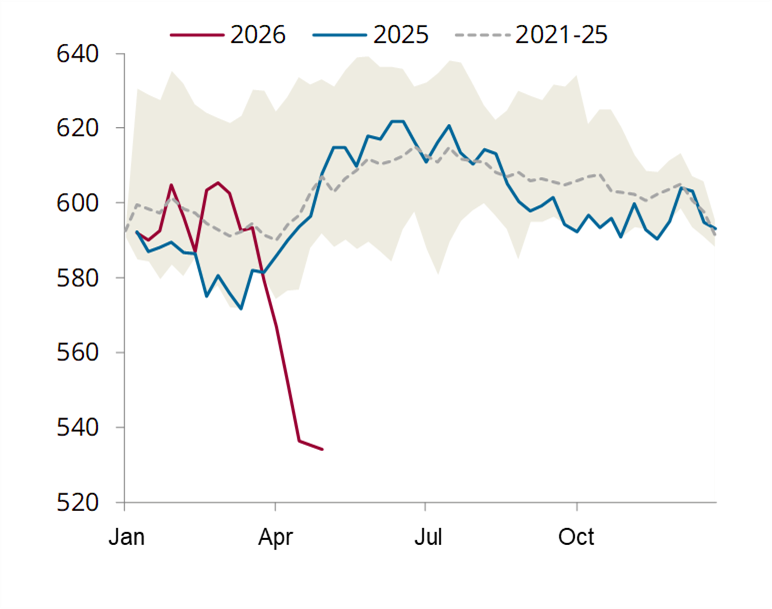
Unsurprisingly, the scale of stockdraws is unprecedented. Since 1 March, Asia (ex-China) has drawn down stocks at a pace of 1.2 mb/d, some of which are SPR, with stocks likely to drop to 500 mb by the end of May, providing just one month’s cover for refineries in the region. Kayrros’ high-frequency data show global crude stocks fell by nearly 50 mb over April, driven by draws in Asia (ex-China) and crude on water. Since the start of the conflict, global crude stocks have been drawn down by 145 mb, with the burden falling overwhelmingly on crude on water as U.S. waivers helped to draw down all the built-up Russian oil on water (~80 mb). Jet, diesel, and gasoline stocks are also headed to critically low levels by late May to early June.
|
Figure 1. Asia (ex-China) crude stocks, mb. |
|
|
|
Source: Kayrros, Energy Aspects |
By June, the oil market will have drawn down over 1 bn barrels from government and commercial stocks to cover the supply shortfall caused by the double blockade of the Strait of Hormuz. Those barrels will need to be replaced, whether to rebuild strategic stocks or restore commercial inventories to more normal levels. There may also be the need to meet new strategic stockholding requirements in large non-OECD economies or across Asia, with Japan and Korea also adding more storage. If markets are efficient, some of that future restocking demand should already be reflected in prices. Indeed, the need to return oil to government reservoirs will be a key factor driving the 2027 oil markets.
Energy markets are extremely uncomfortable with broken balances – really big builds or draws that take us out of five-to-10-year ranges – so there has been a widespread assumption that reopening the Strait of Hormuz will be like an immediate return to conditions at the end of February. This is unlikely. By the same logic, the market should also be pricing in the risk that some Middle East Gulf production capacity may not return quickly (or ever) to pre-war levels, particularly from the aging heavy oil fields of Iraq and Kuwait. Qatari NGLs and gas-to-liquids production will also be impaired for several years due to infrastructure damage.
Nine weeks of war have created huge uncertainty, but a few things are clear. The market will enter 2027 with far less oil in commercial storage. Hundreds of millions of barrels of oil and refined products will also need to be diverted into government stocks to rebuild strategic inventories, and perhaps to meet new strategic stockholding requirements in large non-OECD economies. Liquids production in some Middle Eastern countries is also likely to remain below pre-conflict levels for some time after flows normalize. Without more drilling, prices will need to incentivize supply to meet demand – demand has fallen by just over 3 mb/d and pales in comparison to the supply losses, in part because prices have not stayed high enough for long enough, and also because governments around the world are implementing subsidies or capping price increases.
Guest Author


'/%3e%3cdefs%3e%3clinearGradient%20id='paint0_linear_1236_16887'%20x1='428.1'%20y1='73.2452'%20x2='110.599'%20y2='506.746'%20gradientUnits='userSpaceOnUse'%3e%3cstop%20stop-color='%23019247'%20stop-opacity='0'/%3e%3cstop%20offset='1'%20stop-color='%23019247'%20stop-opacity='0.4'/%3e%3c/linearGradient%3e%3c/defs%3e%3c/svg%3e)