
The evolving relationship between China and the GCC countries is examined in a newly released book co-edited by KAPSARC and Peking University’s Institute of Energy. The book traces how these ties have expanded from a primarily hydrocarbon-based trade relationship into a multifaceted strategic partnership encompassing investment, industrial development, technology, infrastructure, finance, and increasingly integrated supply chains.
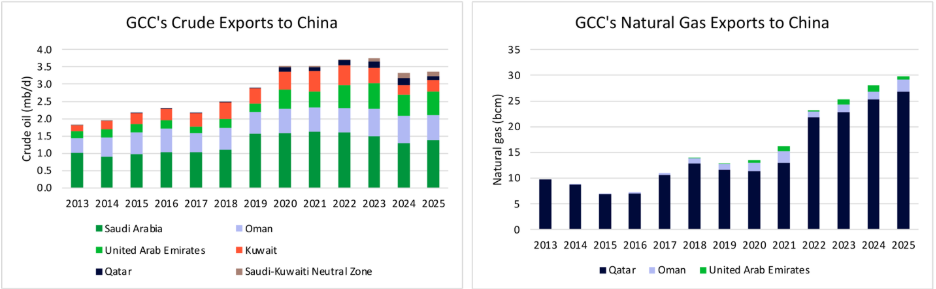
Energy remains at the core of bilateral economic ties. Trade between China and the GCC tripled between 2010 and 2025, reaching a peak of US$315 billion in 2022. China’s imports from the GCC remain heavily dominated by crude oil and natural gas, which accounted for nearly 80% of total import value over this period. GCC crude exports to China have largely plateaued since 2020, while natural gas exports have continued to grow rapidly (Figure 1). Chinese investment in the GCC increased thirtyfold, from around US$1 billion in 2010 to nearly US$30 billion in 2025, with more than 75% directed toward the energy sector. Meanwhile, investment by GCC states in China has remained largely concentrated in downstream energy activities, often linked to long-term crude supply arrangements.
The global energy transition is unlikely to diminish the strategic importance of this energy relationship, but it will change its nature. A future slowdown in China’s oil-demand growth could shift value creation toward lower-carbon hydrocarbons, petrochemical feedstocks, advanced materials, and deeper downstream integration. GCC producers’ relatively low production costs, combined with efforts to reduce the carbon intensity of hydrocarbon production, could strengthen their competitive position while supporting China’s energy and feedstock security.
Beyond hydrocarbons, the energy transition is creating new opportunities for China-GCC cooperation. China has developed large-scale manufacturing and technological capabilities across solar PV, wind, batteries, hydrogen equipment, and other clean-energy technologies. Its 15th Five-Year Plan (2026-2030) envisions a new type of energy system, capable of accommodating a substantially higher share of variable renewable energy while maintaining flexibility, stability, and overall system security. Conventional energy remains important, while emerging technologies – such as energy storage, EV charging infrastructure, demand response, virtual power plants, and water electrolyzers – are expected to play an increasingly important role.
Countries in the GCC, meanwhile, are increasingly integrating net-zero technologies into their broader economic diversification strategies. This includes expanding investment in local manufacturing capacity for renewable energy technologies, developing hydrogen and CCUS hubs, and exploring carbon-trading mechanisms. Combined with expanding ports, logistics networks, special economic zones, and industrial infrastructure, these strengths could enable the GCC to play a larger role as a regional manufacturing, processing, logistics, and re-export hub linking Asia, the Middle East, Africa, and Europe. This development also aligns with the growing interest of Chinese companies in developing regional production and supply-chain networks to navigate growing uncertainty in international trade and investment.
The convergence of these interests and capabilities points toward a more advanced model of China-GCC cooperation, moving beyond individual projects toward more integrated industrial ecosystems. Realizing this potential will require joint efforts to develop local supplier networks, strengthen workforce capabilities, and deepen collaboration in technology and R&D. Greater alignment in technical standards, green taxonomies, transition-finance principles, and ESG disclosure could further reduce transaction costs and facilitate cross-border investment.
The full content of the book is available here.
Guest Author